
Driving a second hand car is, by no means, a rarity and clearly it is not a motoring offence in itself. However, the un-roadworthiness of your vehicle could lead to you being prosecuted for some very serious offences so before you buy a banger on Ebay, read on!
S.40A of the Road Traffic Act 1988 outlines the offence of Using a vehicle in dangerous condition etc and covers a whole host of defects that you may think add a certain charm to your car but could be construed as a danger. We have outlined the common issues to watch out for below:
Cracked Windscreens
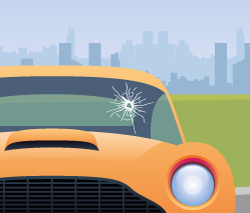 The Highway Code clearly states that the windscreens of a vehicle should be maintained in a good condition to allow the drivers to have a full view of the road. Should you choose to ignore a cracked windscreen you risk a wide range of penalties depending on whether you are involved in an accident or not.
Drivers should pay particular attention to the area directly in front of them as that is known as the most critical part of the windscreen (A-zone). This is 290mm wide and in line vertically with the steering column. This area must not have any damage greater than 10mm across as otherwise the car will most likely fail the annual MOT test. Damage of 40mm anywhere on the windscreen can also cause an instant MOT fail.
It is therefore strongly recommended to routinely check your windscreen and repair it even if there is a small crack as this could quickly spread across the windscreen if left unattended.
Rust
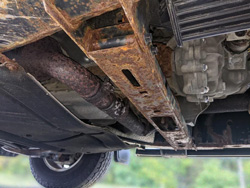 While it is not illegal to drive with a rusted car frame, a rusted car frame can give rise to great safety concerns. There are three different stages of rust development:
- Surface rust- this affects the top layer of the car. This is usually caused by missing paint;
- Scale rust- when the rust starts to impact the body panels;
- Penetrating rust- the rust starts to cut through body panels and impacts the car’s internal system (e.g. brakes, engine etc.)
Rust must be treated at the first stage so that it doesn’t develop and affect the functioning of the car. If the rust spreads there can be significant repercussions well beyond the aesthetics. Badly rusted cars can lead to gas leaks, misalignment and rust could also affect the functioning of the brakes which can be extremely dangerous.
The best way to spot the rust is to take the car to any local body shop or mechanic for an assessment as scale rust and penetrating rust can be difficult to spot.
Tyre treads
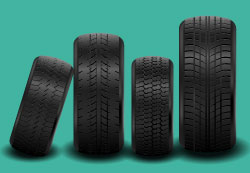 This one does not necessarily apply only to older vehicles. Having roadworthy tyres is an extremely important precondition for any car to be considered safe. Old tyres can be a problem in certain circumstances. In fact, there are some important requirements that must be kept in mind as outlined in Regulation 27 of The Road Vehicles (Construction and Use) (Amendment) (No. 4) Regulations 1990).
- The minimum depth of the tread on the tyres must be 1.6 millimetres
- Tyres should not present any defects (i.e. lumps, bumps and bulges)
- Travelling with a tyre that has a cut/tear bigger than 25mm or it’s more than 10% of the tyre’s width is unlawful
- The tyre’s ply or cord must be covered
- Tyres must be inflated to the pressure indicated in the vehicle’s handbook;
- The vehicle’s handbook must also be checked before fitting tyres to ensure the right type of tyre is being used
Exhaust emissions
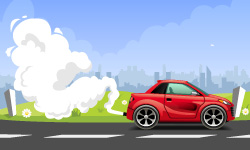 In order to protect the environment from hazardous emissions, exhaust emissions are tested during the annual MOT.
Cars should emit very little smoke except when they start, accelerate hard or climb steep hills. The smoke that comes out of the exhaust can be black, blue or white.
Black smoke is more common in diesel cars and it indicates that there’s too much fuel being burnt by the car’s engine in relation to the amount of air. If it is a one off occurrence then there is nothing to worry about. However, regular black smoke could signify that the air filter is blocked or there is some issue with the fuel injectors. It could also be a sign that the car is over-fuelling. This will mean that the car is in need of urgent repair as this is likely to increase fuel consumption as well as damaging the exhaust system altogether.
Blue smoke indicates that the oil is being burnt. This could be a sign of an unhealthy engine and it is essential to find out where the oil is coming from to diagnose the fault and to repair it. This can be a common occurrence in old cars as when the cylinder walls, the pistons and their valves begin to wear, they allow the oil to pass to the cylinder and get burnt. The engine will therefore need to be either repaired or replaced.
Finally, constant white smoke usually signifies that the coolant liquid is being burnt. This is a sign that the head-gasket has failed to contain the coolant which has leaked from the jacket surrounding the engine into the cylinder where it is burnt. As the wear increases, more coolant will leak into the cylinder causing more steam. This could lead to serious or even irreparable engine damages. Therefore it is essential to turn off the engine as soon as thick white smoke is noticed. In fact, if all the coolant is burnt, the engine will overheat and depending on how hot the metal is, pistons could weld into the cylinder and destroy the engine completely.
Missing wing mirrors
 Wing mirrors are essential as they help the driver see the areas behind and to the sides of the vehicle. This is particularly important in older vehicles that probably do not have the benefit of high tech sensors to help a driver to reverse, change the lane or turn right or left. Cars must have at least one rear mirror fitted inside the car and one wing mirror on the driver’s side. The wing mirror on the passenger’s side is not a legal requirement provided that the other two rear mirrors are intact and effective. The two wing mirrors become a legal requirement only where the internal rear mirror would give the driver no view to the rear of the vehicle.
Brake pads and discs
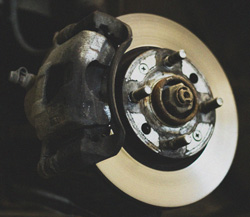 The brake system consists of a pair of brake pads, a brake disc and a brake calliper for every wheel. The pads are fitted inside the calliper. When the brake pedal is pressed, the friction material pushes the pads against the sides of the brake disc.
With time, the pads and the disc wear out and therefore they will need to be replaced. Typically, brake pads can last between 30,000 and 70,000 miles while discs could last a little longer at times. This will, however, greatly depend on how frequently they’re used and the weight of the car.
Most cars now have a sensor that indicates when the brake pads or discs need to be changed. However, older cars that don’t have this feature require more attention. Loud screeching and longer braking times are clear signs that the pads or the discs are worn out and need changing. A grinding noise, on the other hand, signifies that the pads are completely worn out and therefore the car should not be driven at all until the pads/discs are replaced. Bad vibrations and pulling to one side can also indicate a fault in the braking system; this could respectively indicate excessive heat build up or uneven pad wear.
It is also possible to check the outer pad through the spokes of the wheel. If less than 3mm of the pad is visible, it will need to be inspected further to see whether it needs any repair or replacement.
Possible Offences
There are a range of offences that you could be committing if you drive a vehicle with any defects. Much depends on the risk of danger to other.
A danger of injury to any person?
If driving a commercial vehicle, you face an unlimited fine. Drivers will also get three penalty points on their licence.
If driving a private vehicle the maximum fine is £2500.
| Schedule 2 of the Road Traffic Offenders Act 1988 | ||||
|---|---|---|---|---|
| Condition of vehicle/accessories/equipment involving danger of injury (Road Traffic Act 1988, s.40A) | L5 | 3 | B (driver) B* (owner-driver) C (owner-company) | Must disqualify for at least six months if offender has one or more previous convictions for same offence within three years |
If the driver has already been convicted under this section in the previous three years, you risk being disqualified from driving for a minimum of 6 months.
Exemption to endorsement
S.48 RTOA 1988 provides an exemption to endorsement for offences committed under section 40A. Although this is not a defence, the legislation contains a provision that states the Court must not endorse points or a disqualification if the defendant:
“proves that he did not know, and had no reasonable cause to suspect, that the use of the vehicle involved a danger of injury to any person.”
You would still need to enter a guilty plea to the offence. This means you would still have a criminal conviction and be subject to a financial penalty. However, if the exemption is satisfied, you would not receive any endorsement on your licence.
N.B. Having your MOT certificate is not a defence (a vehicle may be unsafe even if you have a current MOT certificate).
How could driving a banger result in a charge of dangerous driving?
Driving a car with major defects could also be an offence under s.2 of the RTA, dangerous driving. This offence carries hefty penalties and can be tried either in the Magistrates’ Court or in the Crown Court. If tried in the Magistrates’ Court, the defendant could face a maximum of 12 months’ imprisonment whereas in the Crown Court this will increase to 2 years. Drivers convicted under this section will also be disqualified from driving for at least 12 months and they will need to comply with an order to sit an extended test of competency to drive.
Section 2A(2) RTA defines dangerous, to include situations where a person drives a vehicle and “it would be obvious to a competent and careful driver that driving the vehicle in its current state would be dangerous.” This also includes anything attached to, carried on or in the vehicle and to the manner in which it is attached or carried. This can include trailers, caravans etc. Therefore, just driving a vehicle that it obviously dangerous, in its current state, could land you with serious repercussions.
It is essential that you do not drive a vehicle if you are aware of a known defect that could cause danger or it is obvious the car is in a dangerous condition. It is also important to note that actual knowledge of the defect is not required under this section if the state of the vehicle speaks for itself.
Section 2A states that dangerous is defined as danger either of injury or of serious damage to property. Regard is given not only to the circumstances which he could be expected to be aware of but also the any circumstances shown to have been within he knowledge of the defendant.
In the case of R v Strong [1995], the term “obvious” was taken as “seen or realised at first glance, evident to him”. In short, where there is no evidence from the Crown that anyone looking at a car, from a layperson’s point of view, would be aware of its dangerous condition, the case is unlikely to be made out.
Defences
The most obvious challenges would be arguing that the vehicle was not in a dangerous defective condition nor would it have been obvious to a competent and careful as defined by s.2A. The defendant will also be able to give evidence, if applicable, that the defects were unknown to them and they could not have been expected to be aware of the same. The defendant is entitled to challenge the Crown’s case to the extent that they cannot make out the elements of the offence beyond all reasonable doubt.
Furthermore, if the vehicle suffered a sudden mechanical defect that you were not aware of, or ought to have been aware of, this could amount to a full defence. In this scenario, it will be for the defendant to prove his argument evidentially. Once the defendant has provided the evidence, it will be for the Crown to disprove it.
